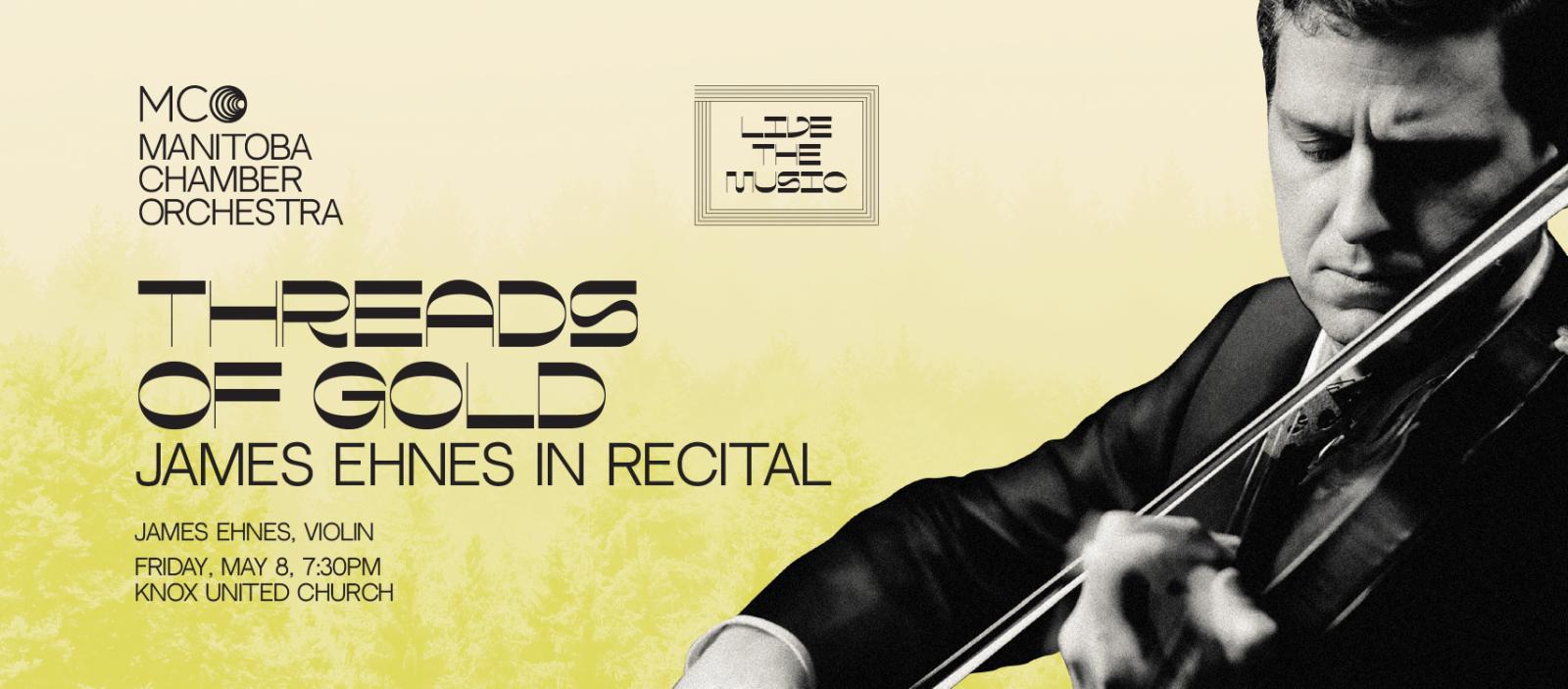
At 50 years young, James Ehnes is just getting started. Marking Ehnes’s 10th collaboration with the MCO (which began in 1992 when he was just 16!), the master violinist takes us on a tour of the greatest and most virtuosic musical offerings of the Late Romantic period. Welcome back, James.
Make sure to listen closely, because Christian Sinding’s Suite im alten Stil (in the Old Style) flies by at the speed of sound! Beginning with a dizzying Presto, Sinding manages to evoke a variety of moods and characters through the relentless semiquavering of the solo violin. Such a movement requires absolute focus and precision, and Ehnes is the perfect fit for the job. The central Adagio is a brief but achingly introspective moment, before giving way to the final Tempo giusto. Listen for the two cadenzas in the piece: a short cadenza in the middle of the movement and a longer metered cadenza that introduces the final refrain.
Brahms wrote the Violin Sonata no. 3 in d minor at the crux of his musical life: the fame of his early symphonies and concertos had given him a reputation from one end of Europe to the other. While relatively compact, the sonata packs in all of Brahms’ trademark: his kaleidoscopic thematic and musical development. The last of three Violin sonatas, Brahms’ work in this piece bravely widened the horizons of the sonata form. One brilliant moment can be heard in the middle of the first movement, where a dominant chord is stretched over 45 measures as the violin and piano slowly grow in intensity, before exploding into an impassioned lyrical climax.
Fittingly, tonight’s program includes a musical mid-life crisis (sorry, James). Referring to the imaginal cells present in caterpillar cocoons, Carmen Braden’s Imaginal continually takes apart and reconfigures the central musical theme, dramatizing the process of metamorphosis. Braden writes that “The universal idea is that we all have our future potentials dormant inside us. And when something catalyzes a major transformation, there is a dissolving of the old which is often hard and we fight against it. But then the incredible and tough and beautiful and surprising rebuilding happens. It is super humanly-relatable to being in a mid-life crisis! - or any kind of big life change…”
Folk music comes to the fore in our finale, Béla Bartók’s Rhapsody no. 1 – especially fitting here, as Ehnes and Andrew Armstrong have recorded two albums of Bartók together, including this piece. It’s a wonderful example of Bartók’s compositional style. Instead of directly setting the folk music of Hungary, he instead tried to distill what he felt were the basic musical characteristics of these traditions into one hybrid compositional style. By experimenting with these characteristics in his music, Bartók began to develop a style that could be described as recognizably Hungarian. The result can be heard in the modal harmonies and melodies of the violin and piano, interspersed with more recognizable dance tunes and rhythms. This work fuses together folk and classical traditions into something that challenges both paradigms.
- Program note written by Lukas Sawatsky